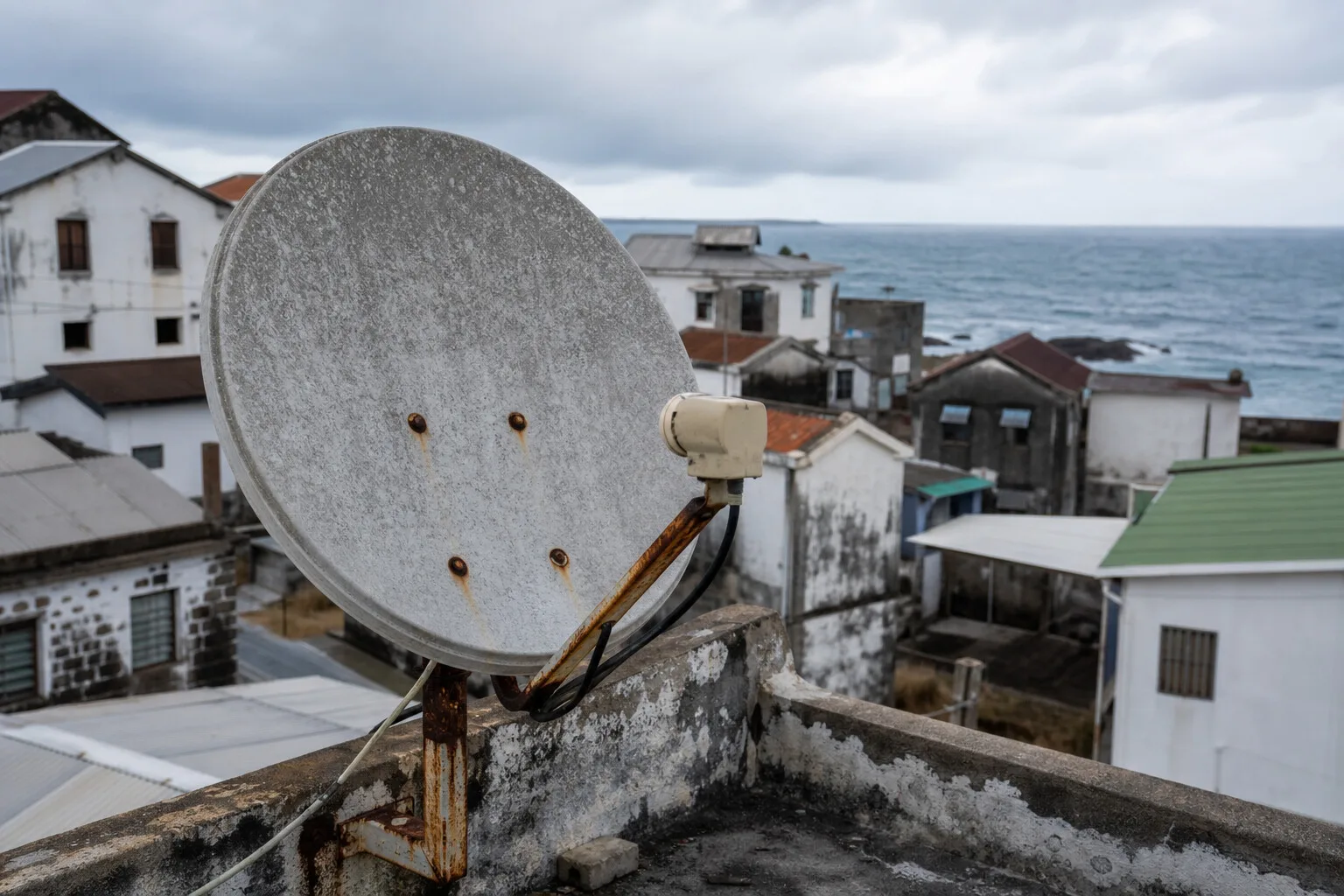
If you live on this coast, you already know the salt gets into everything: hinges seize, braais flake, car panels bubble. Your satellite installation is no different, and it's usually the first thing to suffer when an install was done on the cheap. The frustrating part is that it rarely fails all at once. It fades. The picture that was perfect in summer starts breaking up in the first big winter front, then in lighter weather, and eventually for no obvious reason at all.
Why the coast is so hard on satellite gear
Two forces do the damage around Gansbaai: salt-laden moisture and relentless wind. Salt air carries fine, conductive, corrosive moisture that settles on every exposed surface. It works its way into connectors, eats the copper braiding inside coaxial cable, and rusts cheap brackets and bolts. The south-easter then adds mechanical stress: a dish on an exposed gable is pushed and vibrated thousands of times a season, and anything slightly loose gets looser.
Put the two together and you get the classic coastal failure pattern: a connector that lets in a little moisture, corrosion that raises resistance and weakens the signal, and a bracket that loosens just enough to nudge the dish off its precise aim. Each problem is small. Together they turn a strong, stable signal into one with no margin: fine on a clear day, gone the moment cloud or rain arrives.
Where the damage actually happens
When we open up a struggling coastal system, the trouble is almost always in the same handful of places:
- The LNB and its connector: the weather-facing joint at the dish, where unsealed fittings let salt and water creep in.
- Cable ends and joints: every unsealed termination is a doorway for moisture, and the braiding wicks it further along the run.
- Brackets and bolts: cheap, non-galvanised hardware rusts, stains the wall and loses its grip on the dish.
- The dish surface and mount: pitting and a slowly drifting aim from wind load.
None of this means satellite TV doesn't belong on the coast: it absolutely does. It just means the install has to be built for the conditions, not thrown up to the same spec you'd use in a sheltered Cape Town suburb.
How a proper install fights back
The defence is simple in principle and makes all the difference in practice. We use marine-grade brackets, weather-sealed connectors and quality cabling, and we seal every outdoor joint against moisture so salt has nowhere to get in. Mounting position matters just as much: tucking gear out of the worst of the prevailing wind, behind a parapet or on a sheltered face rather than the seaward gable, buys it years of extra life. This is exactly the standard we build into every new DStv installation: it costs a little more in fittings and a lot more in care, and it pays for itself the first winter you don't lose signal.
It's also why we align by meter rather than by eye. A dish set to peak signal quality has the margin to ride out weather; one set to "good enough" is already on the edge before the first cloud arrives. If your dish was originally aimed roughly and has since drifted, a proper dish realignment often transforms the picture on its own.
Spotting trouble before it ruins movie night
Catch the early signs and a quick service now saves a full re-install later. Watch for a picture that pixelates only in bad weather, error codes that come and go, rust streaks on the wall below the dish, or a dish that looks even slightly more tilted than it used to. If you're seeing any of those, it's worth a look: and if it all started right after a storm, our guide to the five signs your dish needs realigning after a storm walks through exactly what to check.
When to act
If your setup is more than a few years old and was never sealed properly, a quick service now is far cheaper than a full re-install after it fails mid-storm. We'll re-seal the connections, swap any corroded fittings, re-align the dish to peak signal and check the mount is solid against the wind: usually in a single visit, often the same day. The goal is a system you stop thinking about, because it simply works through whatever the coast throws at it.
As the DStv installers in Gansbaai who deal with this coastline every week, we build that same salt- and wind-proofing into every satellite dish installation and alignment we carry out.
Salt air is patient, but it's not unbeatable. Build for it from the start, keep an eye on the early warning signs, and your dish will outlast the cheap one up the road by years. If you'd like us to take a look at yours, we're a quick local call away.
Keep reading
Setting up DStv & WiFi in your Gansbaai guesthouse or holiday let
Guests expect great TV and WiFi. Here's how to set up your let so it impresses: and so…
GuidesDStv Decoder Cables in Gansbaai: 4 Leads and Easy Fixes
Black screen or E48-32 again? Here is what each DStv decoder cable does, why salt air and wind…
home-technologyBest TV Brackets for Bedrooms, Lounges and Patios
Bedrooms, lounges and patios each need a different bracket. Here's how we match TV brackets to the room,…