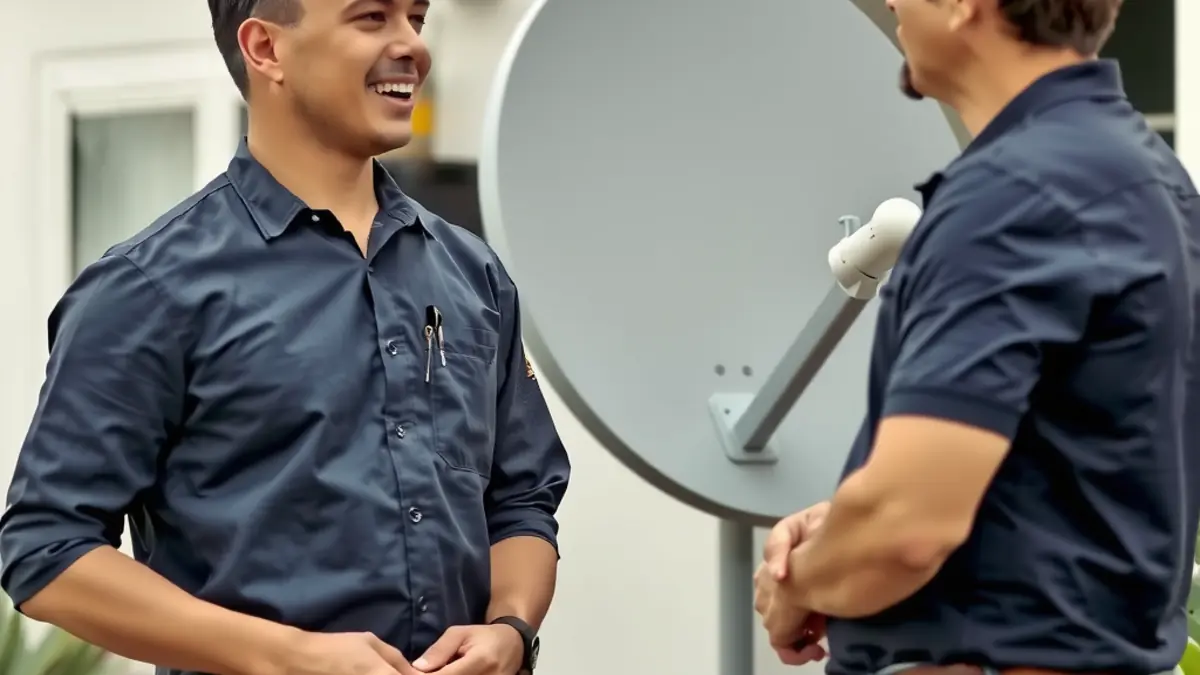
Choosing a DStv installer in Gansbaai is not only about finding someone who can make a picture appear. The installation also has to remain secure, tidy and serviceable in a coastal town where wind, salt and winter rain expose weak mounting and poor connector work. A few questions before booking can help you distinguish a properly scoped job from a quick temporary fix.
This checklist applies whether you need a new installation, a fault repaired, a decoder moved or television points prepared for a holiday property.
Start with the exact job, not a generic price
Describe the property, decoder model, number of TVs and current fault or goal. Mention whether the home is in Gansbaai, De Kelders, Kleinbaai, Franskraal, Pearly Beach, Stanford or another Overberg location. Access time and travel can affect scheduling, while roof type and building layout affect the scope.
A capable installer should ask questions before naming a final price. For a new system, ask what is included in the DStv installation. For a fault, explain the error message and whether every channel or only one TV is affected.
Ask how the problem will be diagnosed
A blank screen can have several causes. The decoder may not be receiving satellite signal, the television may be on the wrong input, a connector may be loose, or the fault may be limited to a second viewing point. Replacing equipment without testing can waste money and leave the real fault in place.
For signal repair, ask whether the installer will check signal readings, connectors, cable condition, the LNB and the stability of the bracket. If alignment is suspected, proper dish alignment requires measured adjustment, not turning the dish until a picture briefly returns.
Inspect the proposed mounting and cable route
Mounting position
The installer should choose a structurally suitable position with a clear satellite path and reasonable access for future maintenance. A hidden position is not better if nearby vegetation or a roof edge obstructs the signal. A convenient position is not better if the bracket cannot be anchored securely.
Cable workmanship
Outdoor cable should be supported at sensible intervals, protected from abrasion and routed so water does not follow it into the wall. Indoor sections should not cross walkways or hang loosely behind furniture. Ask how unused cable entries will be closed and how exterior connectors will be protected.
Equipment compatibility
The correct LNB and switching arrangement depend on the decoder combination. If you are upgrading, the installer should confirm that the proposed Explora or Ultra setup works with the dish equipment and home network. For two-decoder viewing, ask how the Extra View installation will be configured and tested.
Seven questions to ask before booking
- What exactly is included? Request a written scope covering equipment, labour, cable and configuration.
- What might change the price? Roof access, concealed routes and replacement hardware should not appear as unexplained surprises.
- Will existing equipment be tested? Reuse should be based on condition and compatibility.
- How will the dish be aligned? Signal measurement matters more than a picture-only check.
- How will outdoor connections be sealed? Gansbaai conditions make this a practical question.
- What workmanship support applies? Get the terms in writing and keep the invoice.
- What will be tested at handover? Every decoder, TV point, remote and network feature in scope should work before the job closes.
Warning signs in a quotation
- A final price is offered without asking what equipment or access is involved.
- The quote says only “installation” and does not identify hardware or cable allowance.
- Every fault is diagnosed as a complete replacement before testing.
- The proposed cable route is not discussed.
- No one will explain which decoder features require an internet connection.
- The installer will not provide an invoice or describe workmanship support.
These signs do not prove poor work, but they create avoidable uncertainty. Ask for clarification before committing.
Check whether the installer covers the whole project
A move may require more than taking down a dish. Good relocation and reconnection planning includes the old property, transport of approved equipment, cable routes at the new home and decoder testing after reconnection. If the television is changing position, coordinate wall mounting so power, signal and network points end up in the right place.
For accommodation businesses or shared buildings, ask whether the installer understands the difference between an ordinary home arrangement and commercial DStv or communal distribution. Subscription and distribution decisions should be confirmed for the property rather than assumed.
Local knowledge should lead to better planning
Local experience is useful when it improves practical decisions, not when it becomes a vague sales claim. An installer familiar with the Gansbaai area should account for exposed elevations, access routes and long travel distances to outlying properties. In a holiday house, they should also ask who can provide access and who will receive handover instructions.
For Pearly Beach or rural stretches toward Stanford, share a location pin and any gate or key arrangements before the appointment. For De Kelders and other exposed coastal positions, discuss safe access and bracket condition rather than assuming a standard ladder setup.
What to check before the installer leaves
- All required channels and viewing points display correctly.
- Recordings and decoder communication work where included.
- Cables are clipped, labelled where useful and not under strain.
- Wall openings are finished and exterior connections are protected.
- The television and decoder remotes are understood.
- You have the invoice, scope and support contact details.
Take a photo of the decoder labels and the final equipment arrangement. This makes future troubleshooting easier, especially when a property manager or guest reports a fault.
Compare value, not only the lowest total
The best quote is the one that solves the defined problem with suitable equipment and verifiable workmanship. It may be the lowest quote, but price alone cannot show whether testing, proper cable management and handover are included. Compare the same scope, ask direct questions and choose the installer who answers clearly.
Preparing to book a DStv installer in Gansbaai? Keep this checklist beside your quotes and make sure the scope reflects your actual property and viewing needs.
Frequently asked questions
What information should I give a DStv installer before booking?
Provide the area, property type, decoder model, number of TVs, symptoms or desired setup, roof access details and whether there is an existing dish. Photos can help the installer understand the likely scope.
Should a DStv installer test the old dish before replacing it?
Yes. The dish, bracket, LNB, cable and connectors should be assessed. Replacement may be justified, but it should follow a condition and compatibility check rather than an assumption.
How can I tell whether dish alignment was done properly?
The installer should use signal readings and test the decoder after tightening the mount. A picture-only check may miss a low signal margin that becomes a problem in ordinary bad weather.
Do I need a specialist for Extra View?
Extra View needs compatible decoders, the correct signal distribution and correct configuration. Use an installer who can explain the proposed arrangement and test both viewing points before handover.
What should be included in workmanship support?
The written terms should identify what installation work is covered, how faults are reported and what is excluded. Equipment warranties may be separate, so keep model details, invoices and any warranty documents.
Keep reading
How Much Does a TV Mount Stand Cost?
TV mount stand prices depend on the type, the fittings and the fitting work. Here's how the options…
SecurityHow Many Cameras Can a 16 Channel DVR Camera System Run?
A 16 channel DVR runs 16 wired cameras, and some hybrid models take a few IP cameras too.…
GuidesHow to Activate OpenView Decoder in Gansbaai: 3 Easy Ways
Stuck on channel 100? Here is how to activate an OpenView decoder in Gansbaai with your phone, WhatsApp…