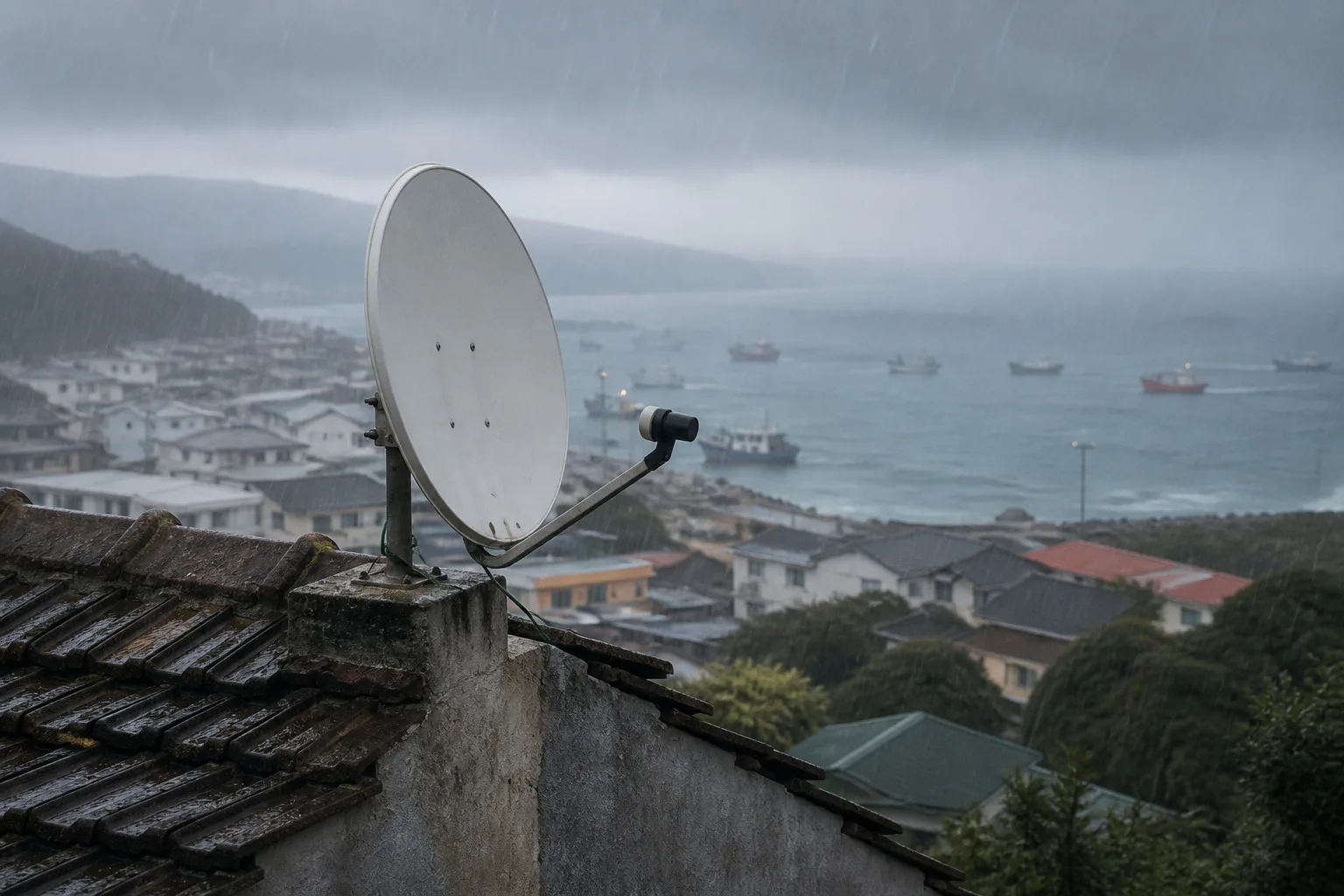
A storm rolls in off the bay, the wind picks up, and right on cue the picture freezes, pixelates or drops to a "searching for signal" message. It's one of the most common calls we get on the Overberg coast: and before you panic or assume the worst, it's worth understanding what's actually going on, because some of it you can check yourself in a couple of minutes.
First, what's normal: rain-fade
Satellite signals travel a very long way, and heavy rain and dense cloud genuinely weaken them by the time they reach your dish. A brief bit of break-up during the very heaviest part of a downpour can be normal even on a healthy system: it's called rain-fade, and it clears as the worst of the weather passes. If your picture wobbles for a few minutes during a cloudburst and then recovers fully, that's usually nothing to worry about.
The problem is when it's more than that: break-up in moderate weather, signal that doesn't come back when the rain eases, or trouble that's getting steadily worse storm after storm. That's not normal rain-fade: that's a system with no margin, and it's telling you something.
The quick checks worth trying
Before you call anyone, a few simple checks are worth a minute of your time:
- Check all your connections. Make sure the cables into the back of the decoder and the TV are pushed home and not loose: surprisingly often, that's the whole problem.
- Restart the decoder. Switch it off at the wall, wait thirty seconds, and switch it back on. It clears a lot of temporary glitches.
- Note the error code. If you're getting a specific message like E48-32, jot it down: it helps us diagnose the fault faster.
- Look at the dish from the ground. If it's visibly more tilted than usual after a big blow, the wind has probably moved it. Don't adjust it by hand.
If a restart and a connection check bring it back and it stays stable, great: you've saved yourself a call-out. If it doesn't, the weather has likely exposed an underlying weakness.
What the weather is really revealing
Here's the key insight: bad weather rarely causes the fault. It reveals one that was already there. A dish that's drifted slightly off aim, an LNB that's started to fail, a connector that's let in a little moisture, or cabling that's corroding in the salt air: any of these leaves your signal with too little margin. On a clear day there's just enough to work; in a storm, there isn't, and the picture falls over. The underlying culprit is usually the slow coastal damage we cover in why salt air is the enemy of your satellite setup.
So if your signal only ever struggles in bad weather, the real fix isn't to wait for the sun: it's to restore the margin. That means re-aligning the dish to peak signal, re-sealing the connections and replacing whatever has corroded, which is the heart of a proper DStv signal repair. Once the margin is back, the same storm that used to freeze your picture barely registers.
When it started right after a storm
If your trouble began immediately after one specific big blow: rather than creeping in gradually: there's a good chance the wind physically knocked the dish out of alignment. The fixes and tell-tale signs for that are slightly different, and we've set them out in five signs your dish needs realigning after a storm. Either way, the message is the same: don't climb up and start adjusting things yourself. A quick metered realignment usually has you sorted the same day, and it stays sorted.
If the quick checks don't fix it, we're the DStv installation Gansbaai team on call for exactly this: book a DStv signal repair and we'll find the real fault, not just the symptom.
Lost signal in a storm is frustrating, but it's also one of the most fixable faults we see. Try the quick checks, note any error code, and if it doesn't come right, give us a shout: we'll find the real cause and set it up to ride out the next front.
Keep reading
5 signs your dish needs realigning after a storm
A big blow can knock your signal just enough to ruin movie night. Here are five tell-tale signs…
GuidesHow to Activate OpenView Decoder in Gansbaai: 3 Easy Ways
Stuck on channel 100? Here is how to activate an OpenView decoder in Gansbaai with your phone, WhatsApp…
tips-guidesMoving House in Gansbaai: DStv Relocation Checklist
A DStv move goes more smoothly when television equipment is treated as a small project, not as a…