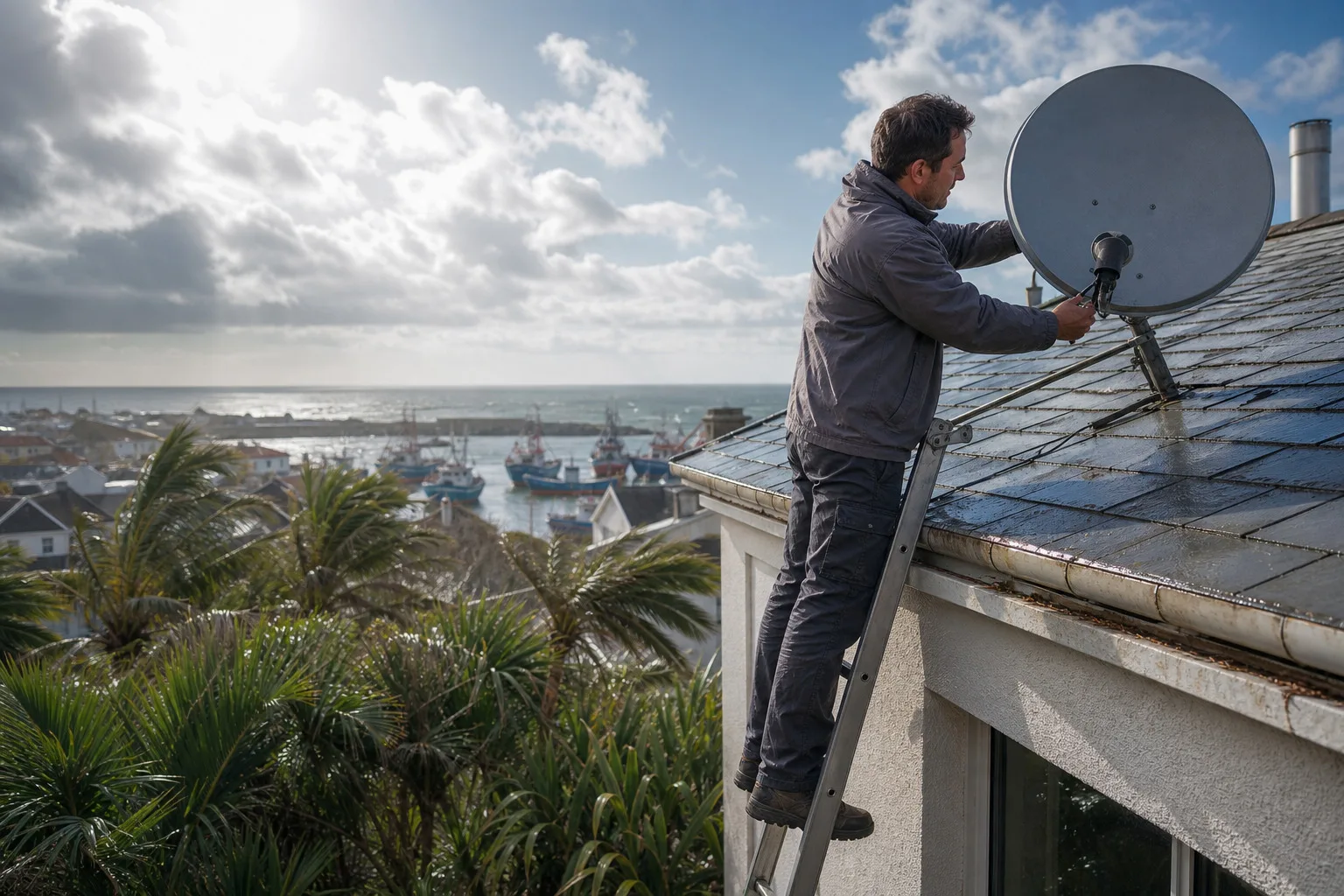
After a proper Overberg storm, satellite dishes often shift a fraction: enough to cause real trouble without ever looking obviously wrong from the ground. The wind doesn't have to rip the dish off the wall to ruin your picture; it only has to nudge it a degree or two off the satellite, or loosen a bracket just enough to let it drift. Here are the five signs we look for, and what each one usually means.
1. Pixelating only in bad weather
If the picture breaks up the moment clouds roll in but is perfect on a clear day, your signal margin has dropped too low. A well-aligned dish has headroom: enough signal strength to punch through rain and cloud. When the aim drifts, that headroom shrinks, so the system copes on a sunny afternoon and falls over the instant the weather closes in. This is the single most common post-storm symptom, and it's almost always an alignment or sealing issue rather than a decoder fault.
2. Recurring error codes
Messages like E48-32, "no signal" or "searching for signal" that come and go are a classic sign of a dish that's drifted or a connection that's started letting in moisture. The "come and go" part is the clue: a totally dead system points to something failed outright, but an intermittent error usually means a marginal signal that dips below the threshold under certain conditions and recovers when they ease.
3. A visibly tilted dish
Take a look from the ground. If the dish sits even slightly differently to how it used to: a little more tilted, rotated, or drooping: the wind has likely moved it. Don't be tempted to nudge it back by hand: alignment is a meter job measured in fractions of a degree, and "by eye" almost always makes it worse. You might get lucky and improve it briefly, but you won't hit the peak, and you'll be back to pixelating within weeks.
4. The signal got worse after a specific storm
This one sounds obvious, but people often don't connect the two. If your TV was fine and then started playing up right after a particular big blow, treat that as a strong hint. Storms are when dishes move, brackets loosen and water gets forced into connectors that were only just sealed. A sudden change after a known weather event is almost never a coincidence: and it's exactly the kind of damage we describe in our piece on why salt air is the enemy of your satellite setup, just delivered all at once instead of slowly.
5. Rust streaks, stains or a wobble
Look at the wall below the dish and the mount itself. Rust streaks mean cheap hardware is corroding, and corroding hardware loses its grip: which is how the wind gets to move the dish in the first place. If the mount has any play in it when the wind gusts, the aim will never stay put until that's sorted. On an exposed coast, the mount is as important as the alignment.
What to do about it
Spotting two or more of these? A quick realignment and re-seal will usually have you sorted the same day. We meter the dish back to peak signal quality, replace any corroded brackets or connectors, weatherproof the joints, and check the mount is solid against the next gust: so it stays fixed rather than drifting back in a month. That's the whole point of a proper dish installation and alignment: not just to get a picture today, but to give the signal enough margin and the mount enough strength to ride out the weather.
If any of these signs sound familiar, call in an accredited Gansbaai DStv installer for a proper satellite dish alignment rather than risking it yourself.
If the picture has already gone completely, or you're getting a total blackout rather than weather-dependent break-up, that points more towards a failed component than a drifted aim: and our guide on what to do when your signal drops in bad weather runs through the quick checks worth trying before you call. Either way, don't climb up to adjust it yourself; let a meter do the talking.
Keep reading
DStv Decoder Cables in Gansbaai: 4 Leads and Easy Fixes
Black screen or E48-32 again? Here is what each DStv decoder cable does, why salt air and wind…
GuidesDStv Installation Wizard in Gansbaai: 7 Steps and Step 4 Fixes
Every DStv installation wizard screen explained for Gansbaai homes, why the setup stalls on the step 4 signal…
ConnectivityHow to Connect DStv Explora to WiFi in Gansbaai: 3 Easy Ways
A plain guide to connecting your DStv Explora or Explora Ultra to WiFi in Gansbaai, with the official…